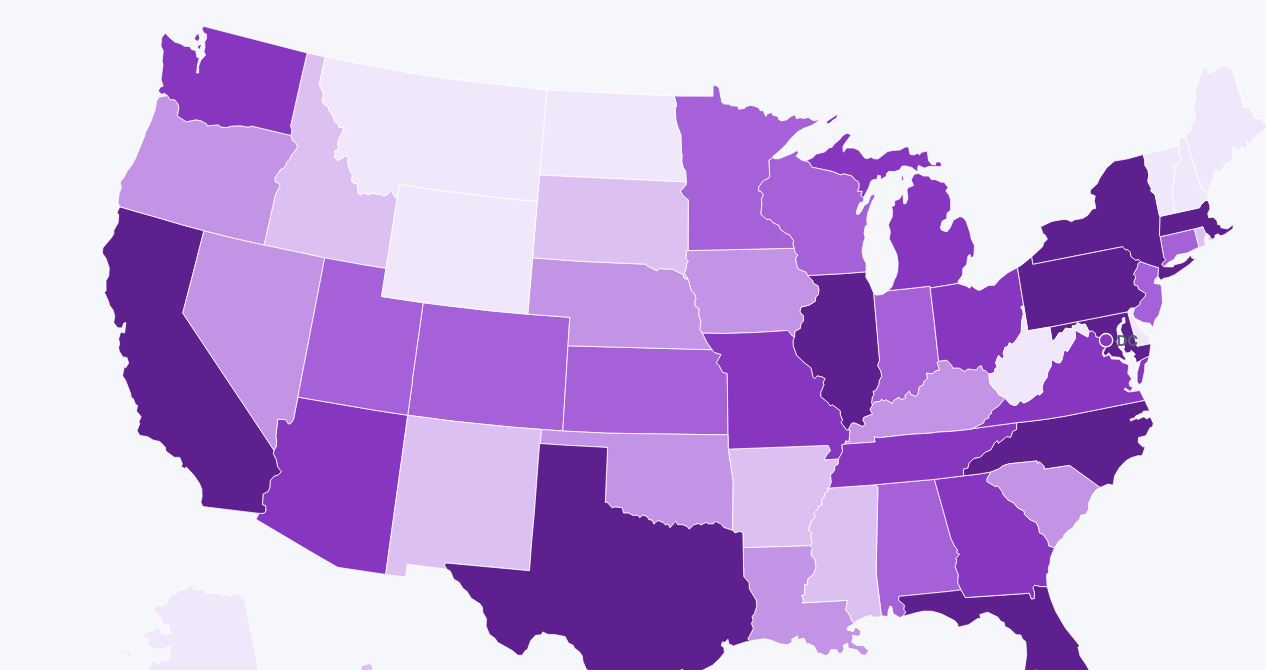
Foundations that accept unsolicited grant requests, by state: Texas 794, New York 678, California 622, Florida 513, Pennsylvania 501, Ohio 428, Illinois 408, Massachusetts 374
Interactive

Which Foundations Accept Unsolicited Grant Requests?

Every private foundation states on its tax return whether it will read a request it did not invite. Of the 131,545 that answer, 27,218 say yes, about 21%. Nobody publishes that list, so we built it from the Form 990-PF filings: 8,971 foundations by state, with the deadline, the restrictions, the contact and every grant paid.

Across 29 client LexisNexis searches and 33,771 articles, 49% of what came back was a duplicate of another article in the same file or about a different person entirely
Research

A Name Search Is Not a Research File

A Lexis name search matches letters, not people. Across 29 client searches and 33,771 articles, 49% was a duplicate or somebody else entirely. Duplicates run at a steady 31%. Wrong‑person hits swing from 1% to 94%, and the candidate’s name decides which — in one race, 2,997 articles produced 115.

Nine of forty-five progressive primary challenges to sitting House Democrats have won since 2016; the challengers who won held 28.1% of the money raised in their race against 31.1% for the ones who lost, and had 3.5 times as many donors
Research

Donors Beat Dollars

Since 2016, 45 sitting House Democrats have faced a credible challenger measurably to their left, and nine of them lost. Money did not separate the two groups — the challengers were outspent roughly 2.5 to 1 whether they won or lost. Donors did: a median 905 against 258.

About 16 million American voters will use a chatbot to help decide at least one contest in November 2026, 42 million will run an election-related query through an AI, and 69 million will read AI-generated text while researching their ballot
Research

Voters Photograph the Ballot, Get Refused, and Ask Again

About 16 million Americans will use a chatbot to help decide at least one contest in November — and the dominant way they do it is not asking who to vote for. It is photographing the ballot, being declined, and rephrasing until the model answers. Where it lands runs inverse to attention: negligible for Senate, decisive for the judicial and county races that carry no party cue at all.

Doubling the number of separate organizations giving, at identical dollars, is worth 1.11 points of vote share to a challenger and minus 0.48 to an incumbent, across contested congressional races from 1980 to 2024
Research

One Move Helps a Challenger and Hurts an Incumbent

Campaign money gets reported as one number. Split it by how many separate organizations it came from, hold the dollars fixed, and doubling that count is worth +1.11 points of vote share to a challenger and −0.48 to an incumbent. Pooled across everyone it reads +0.33 and looks like noise, because the two halves cancel. Contested House and Senate races, 1980–2024.

Thirteen sports signings where the warning was already in a court file, a published suspension or a video on the news before the contract was signed
Research

Most Of It Was Already On The Record

The standard defence of a bad signing is that nobody could have known. Joe Mixon’s video had been on television for four months. Tyreek Hill was still serving probation. Greg Hardy had been found guilty at trial. Thirteen cases where the club had the information first, how long it had been public, and what each signing cost.

Five claims about union political money tested one at a time: it wins ballot measures and gets pro-labor bills written, it does not get them passed or change floor votes, and whether it elects allies in close races is not established
Research

What Union Political Money Buys

Unions spend members’ money on politics on a theory nobody has tested end to end. We broke it into five claims and tested each one. Their side wins 33 of 49 ballot measures and the legislators they fund write 4.2× more pro-labor bills — but those bills pass no more often than anyone else’s, and the floor votes barely move.

Campaign Trend Podcast
Media August 12, 2026

Can You Trust a Poll No Human Ever Took?

Civly CTO Matthew Hanauer joins Eric Wilson on the Campaign Trend Podcast to take synthetic polling apart: how the models are back-tested against certified election results, why yes/no questions push AI answers to unrealistic extremes, and why piling on more data — social media included — can make a prediction worse. They land on where it actually belongs: downballot races that could never afford a traditional poll, and pressure-testing a message before the budget is committed.

Across 112 college athletes with published contract values, on-field production and program scale move roster pay while follower count and engagement rate cannot be told apart from zero
Research

Do Followers Raise NIL Pay? We Can’t Detect an Effect

College athletes are told to build a following because the money follows it. Across 112 athletes with published contract values of $500K to $6.5M, once you know an athlete’s position, on-field production and the scale of their program, knowing their follower count adds nothing we can measure to what the school pays. The advice is right about brand deals — and the school is now writing the larger check.

Booster foundations raised $1.69B against NIL collectives' $98.6M across the Division I programs whose funders Civly could verify
Research

NIL Collectives Are 5.5% of the Money

No public record says which organizations fund which college program. We built that link from federal athletic-finance filings and IRS Form 990s, and across every Division I program whose funders we can name, the decades-old booster foundations out-raise the NIL collectives 17 to 1. One school’s booster arm alone out-raises all twelve collectives combined.

The Poll of AIs: five AI models ran the identical synthetic poll on 6,400 simulated voters across eight certified elections; leaderboard of typical miss per engine shows the panel average, about 1 point, beat every single model
Research

The Poll of AIs: A Panel of Models, Not One

Every AI has a house lean, just like every pollster. Five models from five labs ran the identical poll on the identical 6,400 simulated voters across eight certified elections. The panel average beat every single model — typical miss about 1 point — and where the models disagreed, that disagreement pointed at the one race they all misread.

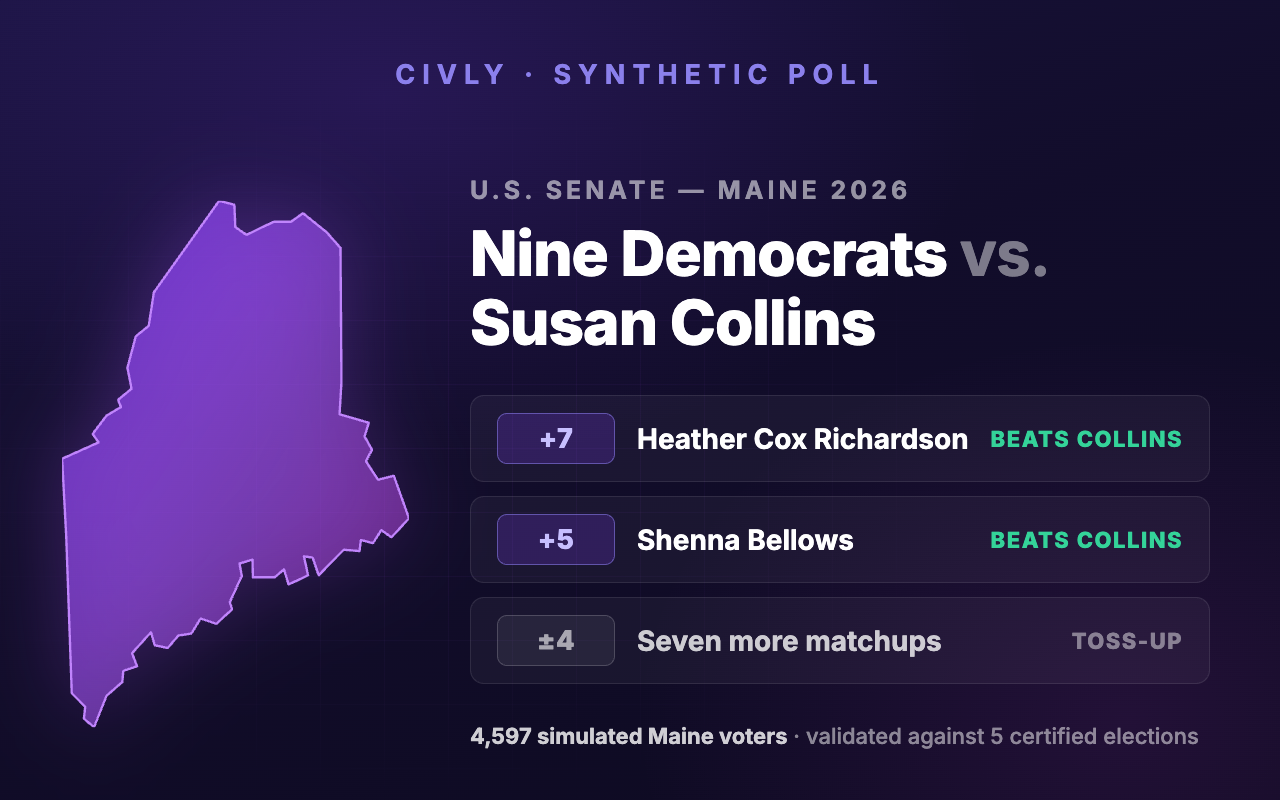
Civly synthetic poll: nine potential Democratic nominees against Susan Collins in Maine's 2026 Senate race
Synthetic Polling

Maine 2026: Nine Democrats Against Susan Collins, Simulated

If Graham Platner exits the race, which replacement keeps the seat competitive? We ran all nine potential Democratic nominees head-to-head against Collins on a simulated panel of 4,597 real registered Maine voters, validated against five certified Maine elections. Two beat her outside the margin of error — the rest are toss-ups.

The Civly Turnout Score
Research

The Civly Turnout Score: Beating the “Voted Last Time” Rule

Every campaign targets “likely voters” the same way: did you vote last time? It misses badly on the low-turnout races that decide most offices, and writes off new voters entirely. Our turnout model calls it right 84% of the time across nine states (versus 78%), winning in all nine.

Civly Synthetic Polling scorecard: 9 of 10 winners called correctly in the 2026 New York and Maryland Democratic House primaries
Synthetic Polling

9 of 10. We Called the 2026 Primaries Before a Vote Was Cast.

We forecast every contested New York and Maryland House primary with AI voter simulation — no phone calls, no door knocks — and published every call in advance. Graded against the certified results, we went 9 for 10. Here's how it works, and the one we missed.

Interactive U.S. map of drug and device company payments to physicians by state
Interactive

What Do Drug & Device Companies Pay Your Doctor?

Federal law requires every pharmaceutical and device maker to report what it pays U.S. physicians — $78 billion since 2018. We loaded the complete CMS Open Payments dataset into an interactive map: explore by state, congressional district, and county — or search any doctor by name.

Democratic Autopsy and AI
Media June 9, 2026

Democratic Autopsy and AI

Writing in The Fulcrum, Civly CEO Daniel Barkhuff argues the DNC's post-2024 autopsy ducked the question every honest post-mortem must ask. The party's 192-page report never once names the most disruptive force reshaping campaigns and how voters get their information: artificial intelligence.

Civly
Press Release

192 Pages on How Democrats Lost. Zero Mentions of AI.

Civly's stance on artificial intelligence, and why the party of science can't afford to look away. We fact-checked the DNC's 192-page post-election report and found the single most disruptive force in the economy didn't earn one sentence in the party's plan for its own future.

How a Startup is Using AI to Streamline Opposition Research
Media February 6, 2026

How a Startup is Using AI to Streamline Opposition Research

Campaigns & Elections covers how Civly founder Dan Barkhuff is leveraging AI to compile data from property records, criminal histories, campaign finance databases, and social media in minutes rather than weeks.

So Here's What I've Been Up To
Blog & Insights January 30, 2026

So Here's What I've Been Up To

Daniel Barkhuff announces the launch of Civly.ai, an AI-powered political technology company designed to help Democratic organizations operate with greater speed and agility in modern narrative-driven politics.

Civly
Press Release

Civly Launches AI-Powered Campaign Intelligence Platform

North Carolina-based startup delivers comprehensive candidate research in days instead of weeks, transforming how political campaigns conduct opposition research.

Media Inquiries

For press inquiries, interview requests, or media information, please contact our team.

Contact Us