
Company / Value
Value you can
put to work.
Research capacity for SLEA. A Clip Library co-created with Alabama Democrats. Savings opportunities identified for Calamigos. Three partnerships, built around the work each team needed done.
 SLEA ↗
435–870
Estimated staff hours saved on research
Alongside daily priority emails and weekly candidate tracking across ten states during the 2026 midterm elections.
SLEA ↗
435–870
Estimated staff hours saved on research
Alongside daily priority emails and weekly candidate tracking across ten states during the 2026 midterm elections.
 Alabama Democrats ↗
115–230
Estimated staff hours saved on clip preparation
1,376 video and focus-group moments cataloged in a Clip Library co-created with the team.
Alabama Democrats ↗
115–230
Estimated staff hours saved on clip preparation
1,376 video and focus-group moments cataloged in a Clip Library co-created with the team.
 Calamigos ↗
≈$2M
Annual savings opportunities identified
Estimated potential from labor and utility analyses.
Calamigos ↗
≈$2M
Annual savings opportunities identified
Estimated potential from labor and utility analyses.
Time-saving estimates model the staff effort to reproduce delivered work manually; they are not measured net savings. Explore the assumptions in each story.
CASE STUDY 01
SLEA
State & local research
Daily intelligence
Hundreds of candidates to track.
Priority updates, every day.
SLEA’s local-candidate tracking roster included ten states during the 2026 midterm elections. Keeping up by hand means repeatedly checking news, social posts, campaign activity, and financial filings, then deciding what needs the team’s attention. Civly brings updates on the highest-priority names into daily emails, alongside tracking and research for the broader program.
What the team asked for
Keep up with a large candidate slate, give the highest-priority races closer attention, and make important changes easy to spot. The team needed current information they could act on, with less staff time spent reopening the same sources and rebuilding trackers.
What Civly keeps moving
- Daily email briefings on the highest-priority names, bringing news and social updates to the team.
- Weekly campaign-finance updates for the candidate roster in the 2026 cycle, with new filings and cash-on-hand figures where available.
- Election schedules and recurring judicial vacancy and appointment tracking.
For the documented tracking roster, even one 10–20 minute review per candidate each week represents an estimated 18–36 hours of work. At an illustrative $50 per staff hour, that is $3,600–$7,200 in labor per four-week month, before daily priority monitoring and deeper research.
How we estimate the ongoing tracking workload
The estimate applies a 10–20 minute weekly check to SLEA’s documented tracking roster, representing 18–36 staff hours per week. Four weeks represent 72–144 hours. At an assumed $50 per hour for staff time, that is $3,600–$7,200 in manual labor.
The assumed check covers looking for changes, reviewing available records, and updating the tracker. Daily emails focus on priority names; this calculation does not assume every candidate receives daily monitoring. It excludes that additional daily work, records-request handling, and deeper research. The hourly rate is illustrative, and the result is a manual workload equivalent, not measured payroll expense or net hours saved.
Hundreds more hours in delivered research.
Alongside the ongoing tracking, Civly delivered 165 judicial profiles, an election calendar across 28 jurisdictions for the 2026 election, a 50-state review for 2027, and finance coverage mapping for the candidate roster. Quick Vet and Full Memo formats were also refined around SLEA’s own rubric and feedback.
Roughly 11–22 full-time workweeks to reproduce the four quantified research workstreams manually: finding records, checking identities and sources, and organizing results for review. This is the research already represented in the deliverables, in addition to the recurring tracking workload above.
How we estimate the time, and how to adjust it
Start with the delivered work, then choose the manual effort for each research workstream. These are estimates of the work represented, not measured net hours saved.
Range: 2–4 hours per judicial profile, 1–2 hours per jurisdiction schedule, 1–2 hours per state review, and 27–54 hours for finance coverage mapping across the roster. Counts exclude duplicate file formats, earlier revisions, and dropped MS/KS/MI profiles. Recurring updates and memo production are additional work outside this estimate. Actual effort varies with source access, reuse, and review depth.
Basis: SLEA’s documented candidate tracking roster and weekly reporting workflow, plus delivered workbooks reviewed in September 2026. Judicial profiles: 87 in Iowa and 78 across Kansas, Michigan, and Mississippi. The July finance audit documented automatic coverage for much of the roster, with other candidates requiring records requests. Initial coverage mapping and subsequent weekly reviews are counted as separate tasks.
Explore research booksCASE STUDY 02
Alabama Democrats
Research & media workflow
Built together
A client request
became a product.
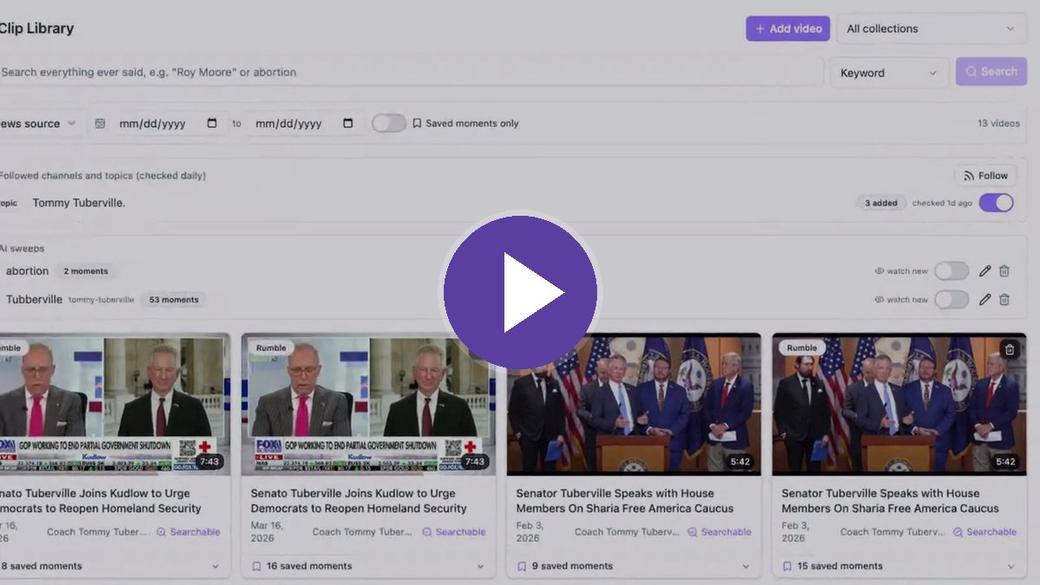
Alabama’s team needed to turn a growing archive of videos, podcasts, and focus groups into material they could find and use. We co-created the Clip Library around that work, from source-linked moments to compilations organized by topic.
What the team asked for
Historical research with transcripts, screenshots, and playable clips. Then a practical next step: bring related moments into one video so staff could start editing with the material already assembled.
What Civly delivered
- Historical clip catalogs with timestamps, source context, and stored video.
- Focus-group transcripts, an indexed catalog, highlight clips, and a synthesis memo.
- Reusable collections and topic compilation tools shaped by client feedback.
- Candidate research books and follow-up research alongside the media work.
At an assumed 5–10 minutes to verify a moment, record its timestamp, tag it, and prepare it for reuse, 1,376 moments represent approximately 115–230 hours of manual preparation.
What the clip estimate includes
825 historical clips + 551 focus-group moments = 1,376 cataloged moments. Multiplied by 5–10 minutes each and divided by 60, that is 114.7–229.3 hours, rounded to about 115–230.
This models preparation after a moment has been identified. It excludes finding and watching the full source footage, writing research books, synthesizing the focus groups, building the product, and producing final compilation videos. It is a manual workload estimate, not a measured turnaround or net time-saving result.
Basis: the historical Clip Library collection documented in August 2026, and the four-group catalog delivered in July 2026. The two counts cover separate source collections.
CASE STUDY 03
Calamigos
Hospitality operations
Savings opportunities
Operational data.
Financial opportunities.
Calamigos needed to make better use of its operating data. Civly helped set up API access, integrated WorkEasy, and supported repeatable reporting that made labor and utility costs easier to examine.
What the team asked for
Access to workforce data, reports they could reproduce, and a clearer view of where operating costs deserved attention. The work connected technical setup with the day-to-day questions of running a hospitality business.
What Civly delivered
- WorkEasy API access and integration with live workforce data.
- Repeatable reporting workflows and tools for reviewing time records.
- Department-level labor analysis and reviews of water, electricity, and propane spending.
- A quantified view of savings opportunities for the team to evaluate.
The labor and utility analyses identified approximately $2 million in potential annual savings, giving the team specific areas to investigate and act on.
- Labor opportunities
- ≈$1.83M / year
- Utility opportunities
- $123K–$173K / year
How the savings opportunity was estimated
The labor analysis estimated $1.828M in annualized potential using 20 weeks of operating data and department cost targets. A separate utility review estimated $123K–$173K annually from water, electricity, and propane opportunities. Together, the reports indicate about $1.95M–$2.00M.
These are opportunities identified in the reports, not realized savings. The labor projection includes seasonal activity; annual results depend on operating conditions and the changes implemented. The financial analyses used operating reports and utility records; the WorkEasy integration was a related workstream within the engagement.
Basis: Calamigos’s 2026 labor-to-revenue analysis and utility executive summary, alongside the documented WorkEasy integration.
Explore the AI OperatorWhat’s taking too much
of your team’s time?
Bring us a recurring research task, an archive you need to make useful, or operating data you need to understand. We’ll work through what Civly can deliver for your team.
Talk through your workflow